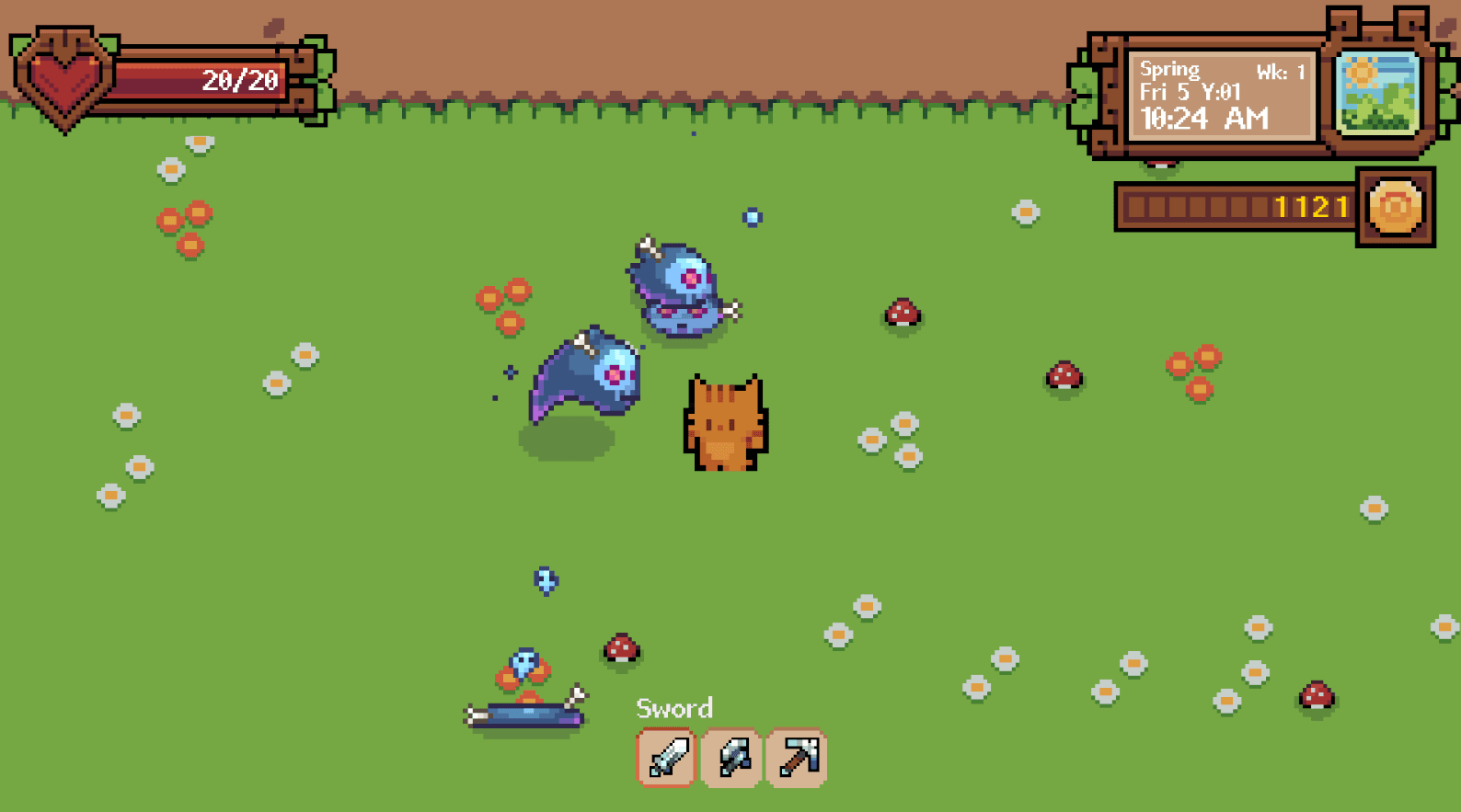
01 · Morning
Explore and gather ingredients
Explore the world and collect ingredients to create different dishes.
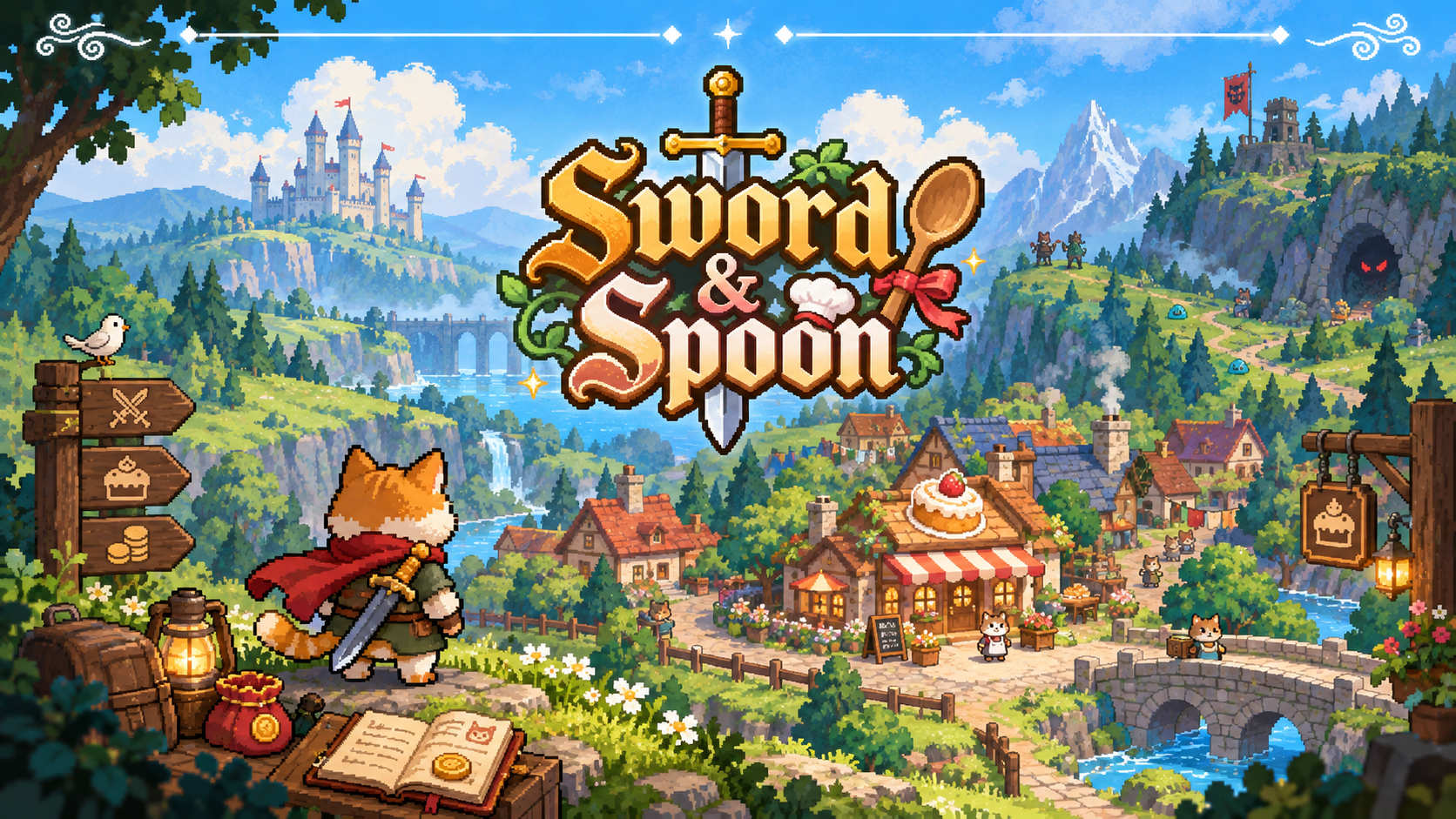
A 2D top-down simulation game that teaches basic bookkeeping by combining double-entry accounting, accounts payable, and accounts receivable with restaurant management and dungeon combat.
What I designed and built in this project
Managed the product backlog in Notion, breaking work into Epics and User Stories so the team stayed aligned throughout development.
Developed the combat system, dungeon generation, and gameplay tutorial, and designed the game-map UI using Unity and C#.
Learning Basic Accounting Through a Simulation Game
Traditional accounting lessons based on textbooks or lectures can feel boring and difficult to understand. Sword & Spoon was developed with Unity and C# as a 2D top-down simulation game that turns basic accounting concepts—including double-entry bookkeeping, accounts payable, and accounts receivable—into core game systems. Players manage a restaurant, explore dungeons to gather ingredients and reduce costs, and record transactions in a General Journal that provides immediate feedback. This lets them learn accounting through hands-on practice in a simulated setting.
The problem this project addresses and the outcome it aims to achieve
Traditional textbook-based accounting lessons can feel monotonous, making students in the target age group (14–24) lose interest and struggle to connect Debit/Credit principles with everyday business activities.
Build a fun business simulation that connects in-game actions—such as buying ingredients on credit or lending money through quests—to double-entry bookkeeping, helping players think critically and remember accounting principles in a structured way.
Pain points in accounting education addressed by the game design
Students find blank accounting tables boring. The game adds ingredient gathering and cooking systems to make learning more engaging.
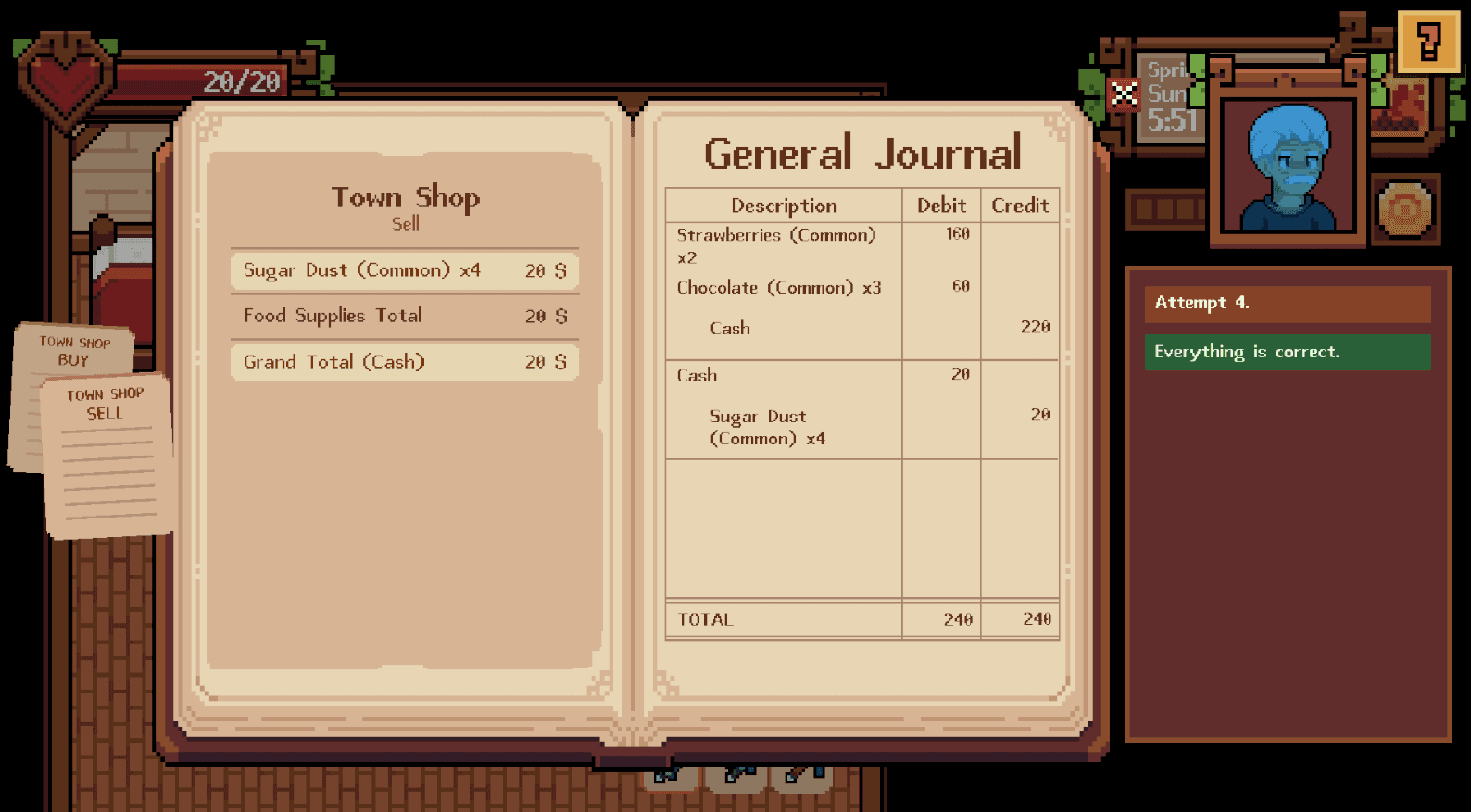
With regular homework, students have to wait for a teacher to review their work before they can spot mistakes. The game's General Journal checks whether entries balance and provides real-time guidance.
Accounts Payable can be difficult to understand without context. In the game, players buy supplies on credit and see the debt and its daily interest accumulate in the debt menu.
An approximate view of planned and actual work from January to May.
Additional context: The accounting and restaurant systems took longer than expected, leaving no time to develop the audio and save systems. Of the quest, event, and boss systems, only the quest system was delivered because the instructor wanted more variety in the quests.
Gameplay is divided into phases, each linking a game activity to accounting practice.
01 · Morning
Explore the world and collect ingredients to create different dishes.
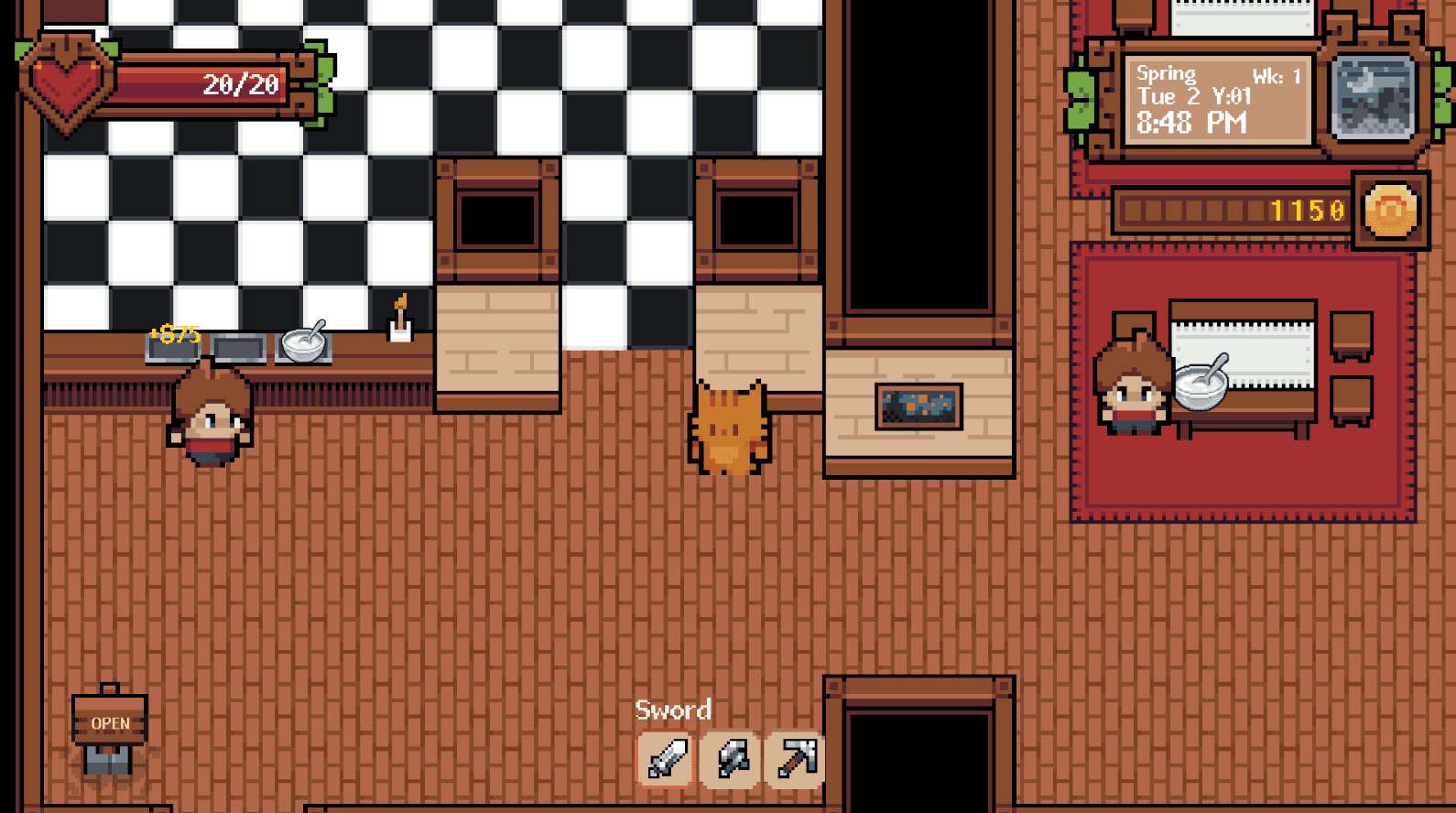
02 · Evening
Prepare dishes with the cooking QTE, then serve customers while the restaurant is open from 17:00 to 22:00.
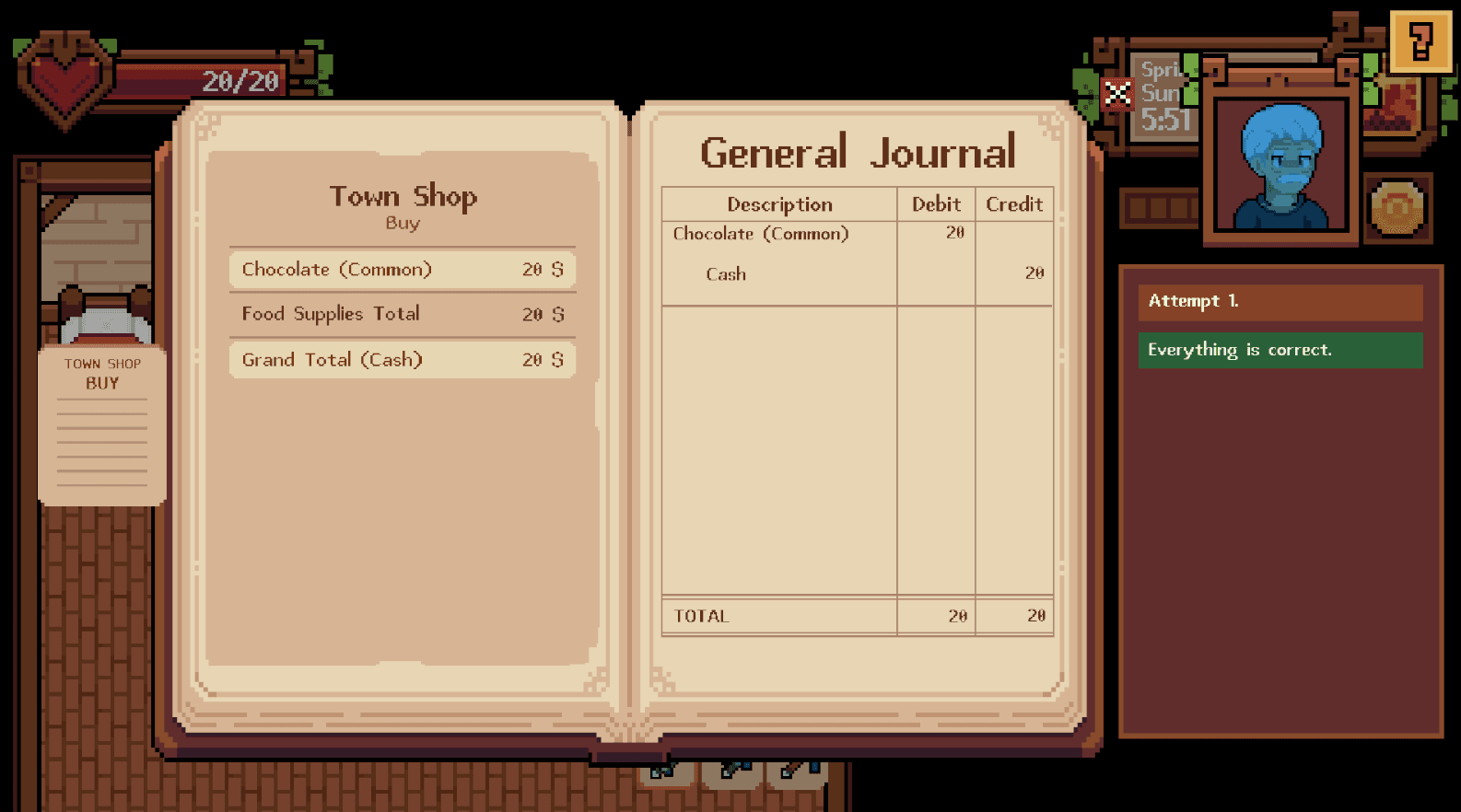
03 · Night
Review Debit/Credit entries in the General Journal and use feedback to reflect on the day's bookkeeping.
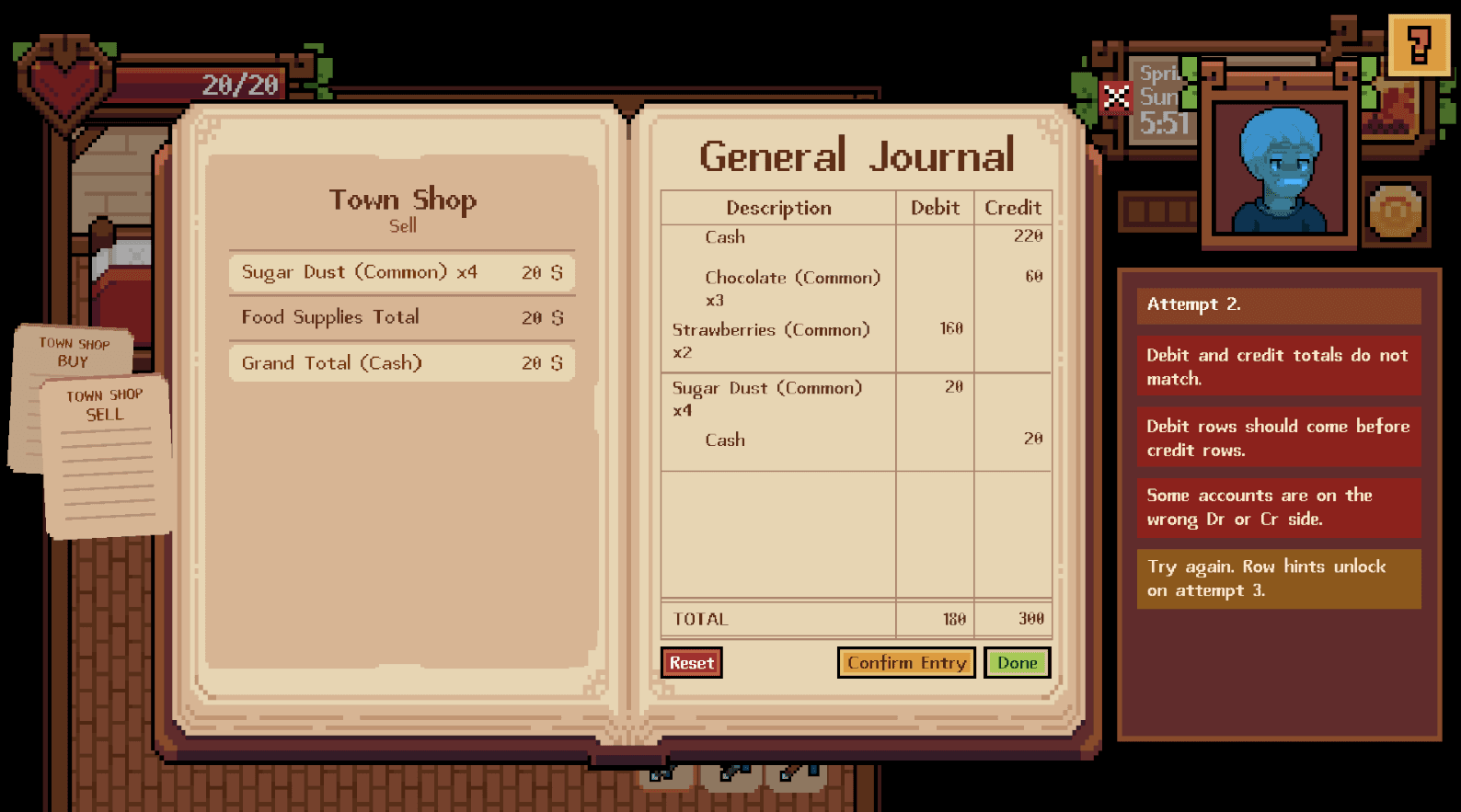
At the end of the day, the player places transaction cards into Debit and Credit. Equal totals are only the first check: the game also needs to explain whether each account is on the correct side.
User Story
As a player learning double-entry bookkeeping, I want immediate feedback after confirming my Journal entries, so I can understand mistakes and apply the rule next time.
01
Given Debit and Credit totals differ, Done stays unavailable and the player sees what must be balanced.
02
Given the totals match, Done becomes available. Matching totals do not by themselves mean the account choices are correct.
03
When Food Supplies is placed in Debit and Cash in Credit for a cash purchase, confirming the entry shows positive feedback.
04
If those accounts are swapped but totals still match, the feedback identifies the wrong sides and explains the Debit/Credit rule.
These are the acceptance criteria written in Notion. Read Story #10 in Notion
Dungeon monsters drop ingredients according to their tier, which players can take back to cook.
Gathered ingredients become restaurant dishes, with prices scaled by dish quality.
| Recipe | Ingredients | Common | Rare | Epic |
|---|---|---|---|---|
| Sugar Glaze | Sugar Dust + Sugar Dust | 50 | 75 | 100 |
| Chocolate Chunk | Chocolate + Sugar Dust | 100 | 150 | — |
| Choco Truffle | Chocolate + Cocoa Butter + Sugar Dust | 250 | 375 | 500 |
| Blueberry Jelly | Blue Syrup + Sugar Dust + Milk Essence | 350 | 525 | 700 |
| Chocolate Mousse | Dark Cocoa + Milk Essence + Sugar Dust | 650 | 975 | 1,300 |
| Blueberry Tart | Tart Base + Blueberry + Blue Syrup | 850 | 1,275 | 1,700 |
Watch a gameplay video of Sword & Spoon.
Evaluation of 10 participants from the target audience (ages 14-24)
81.3%
Overall satisfaction score (81.33/100)
4.41
Usability rating out of 5
4.08
Accounting learning score out of 5
4.17
Player experience (UX) rating out of 5
Satisfaction evaluation from 10 target-group participants across 3 dimensions (Scale 1–5, n=10)
Mean and Standard Deviation of Usability
| Evaluation Item | Mean (x̄) | S.D. |
|---|---|---|
| The game has an easy-to-understand gameplay format | 4.40 | 0.70 |
| Character controls and gameplay are convenient | 4.30 | 0.95 |
| Players can clearly understand quest objectives | 4.20 | 0.63 |
| Menus and UI are clear and understandable | 4.50 | 0.53 |
| The in-game bookkeeping system is easy to use | 4.20 | 0.42 |
| The game's progression is not overly complex | 4.60 | 0.70 |
| Overall, the player feels satisfied with the gameplay | 4.70 | 0.48 |
| Average | 4.41 |
Mean and Standard Deviation of Learning
| Evaluation Item | Mean (x̄) | S.D. |
|---|---|---|
| The game helps understand double-entry bookkeeping principles | 3.80 | 0.92 |
| The game helps understand the difference between Debit and Credit | 4.20 | 0.92 |
| Players can link in-game activities to accounting journal entries | 4.20 | 0.79 |
| The quest system promotes accounting learning | 4.20 | 0.63 |
| The game increases interest in learning accounting | 4.00 | 0.94 |
| Average | 4.08 |
Mean and Standard Deviation of User Experience
| Evaluation Item | Mean (x̄) | S.D. |
|---|---|---|
| The game format makes learning engaging and not boring | 4.40 | 0.70 |
| The balance between 'fun' and 'learning' is appropriate | 4.10 | 0.57 |
| Players want to return and play the game again | 4.00 | 1.25 |
| Average | 4.17 |
Mean and Standard Deviation of Overall Game Satisfaction
| Evaluation Item | Mean (x̄) |
|---|---|
| Overall Mean (15 items, Scale 1–5) | 4.25 |
| Satisfaction Score (out of 100) | 81.33 |
| Satisfaction Level | Good |
A summary of the game's actual results, challenges, and limitations, and how they can inform future development.
01 · Outcome
The prototype combines restaurant management, dungeon exploration, and basic accounting through buying and selling scenarios, journal entries, and immediate feedback.
02 · Challenge
The team had to adjust the cooking minigame's difficulty repeatedly so players with different levels of experience could engage with it.
03 · Limitation
The game has one introductory chapter and was evaluated with 10 participants, so the results cannot yet show long-term learning outcomes.
04 · Next step
Add a Guide Book for reviewing Debit/Credit rules, more advanced accounting lessons, and tools for tracking learning.
Lessons from planning, developing, and testing the game with players
“I learned to break work into Stories so the team could see the system as a whole, understand the scope, and share the same goals. I also practiced prioritizing work and adapting plans during development to respond to immediate problems and constraints. In addition, I learned to turn complex accounting concepts such as Debit/Credit, AP, and AR into game scenarios players can understand by doing. Testing and gathering player feedback also helped reveal problems the team might overlook, so we could improve the UX and systems.”
Scenes from the restaurant, dungeon, and accounting journal
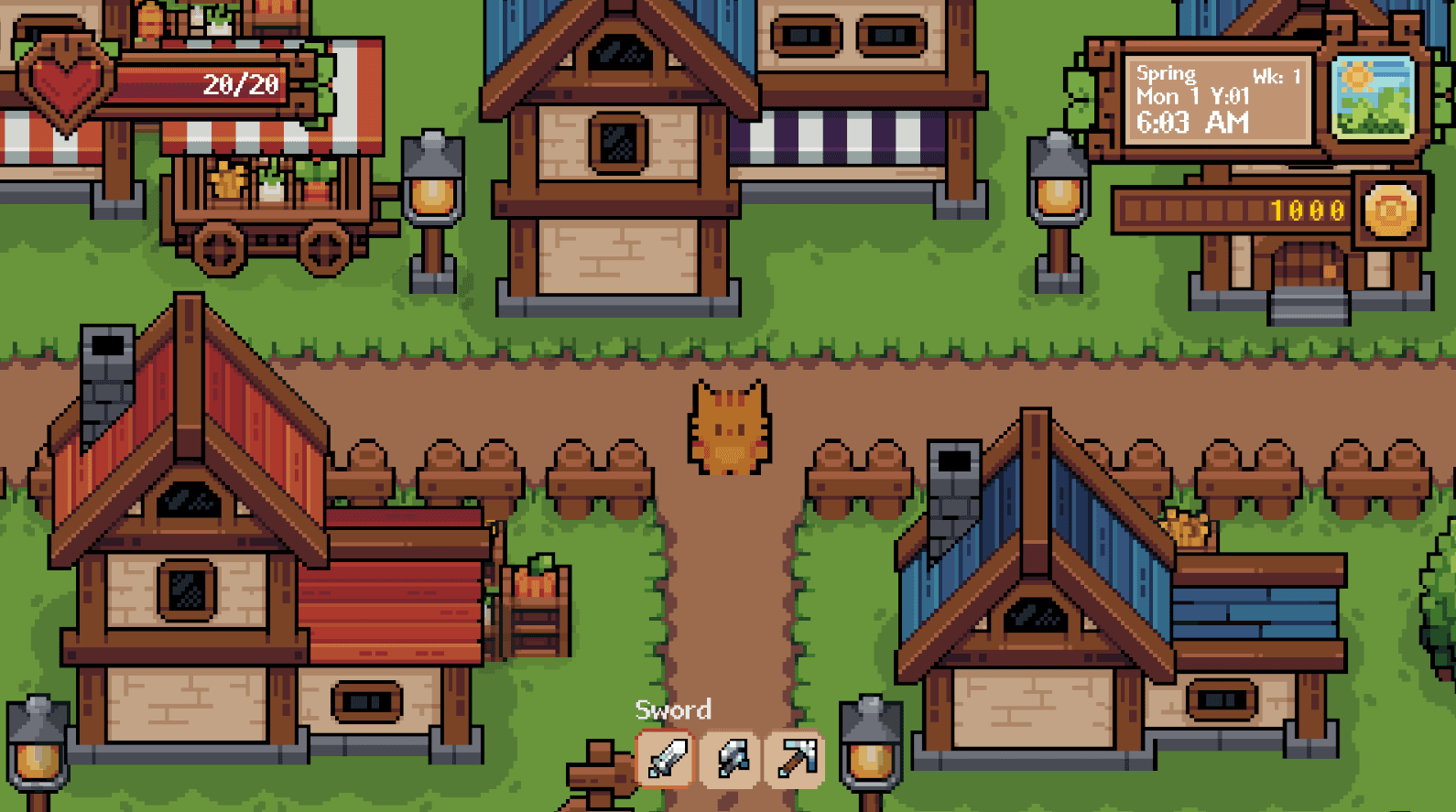
Village Overview & HUD